
52-Week Savings Challenge: How to Complete It and Save $1,378 This Year
If you have ever tried to save money and felt like you just could not get any momentum going, you are not alone. Millions of people start the year with good intentions and then watch those plans fall apart by February. The 52 week savings challenge how to complete it is one of the most searched topics in personal finance because so many people want a simple, structured way to finally build their savings. The good news is that this challenge works, and today I am going to show you exactly how to stick with it from week one all the way to week fifty-two.
Why Most People Struggle to Save Money Consistently
Saving money sounds simple in theory. Spend less than you earn and put the rest aside. But real life is messy. Unexpected bills show up. Your car needs new tires. The kids need school supplies. Before you know it, the money you planned to save has already been spent.
The deeper issue is that most people do not have a clear savings system in place. They rely on willpower alone, hoping there will be something left over at the end of the month. That approach almost never works. If you have been struggling with this, you might benefit from learning how to budget when you are living paycheck to paycheck. Having a budget and a savings challenge working together gives you a much stronger foundation.
The 52-week savings challenge solves the consistency problem by giving you a specific amount to save each week. There is no guessing. There is no hoping. You know exactly what to do, and the amounts start so small that anyone can begin.
How the 52-Week Savings Challenge Works
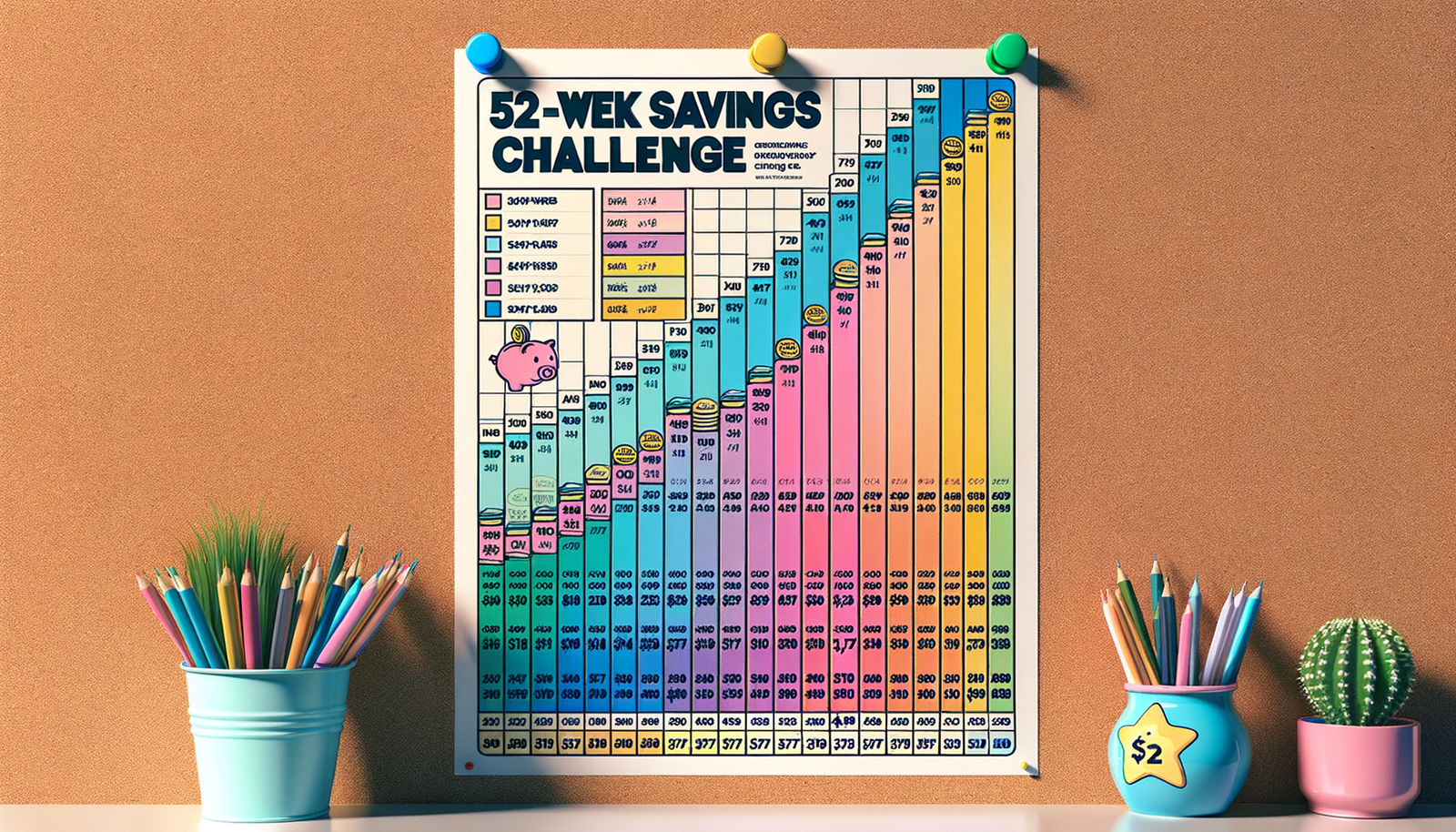
The concept is beautifully simple. In week one, you save one dollar. In week two, you save two dollars. In week three, you save three dollars. You keep increasing by one dollar each week until week fifty-two, when you save fifty-two dollars. By the end of the year, you will have saved exactly $1,378.
Here is a quick snapshot of how it breaks down across the year:
- Weeks 1 through 13 (Quarter 1): You save $1 to $13 per week, totaling $91
- Weeks 14 through 26 (Quarter 2): You save $14 to $26 per week, totaling $260
- Weeks 27 through 39 (Quarter 3): You save $27 to $39 per week, totaling $429
- Weeks 40 through 52 (Quarter 4): You save $40 to $52 per week, totaling $598
Notice how the first quarter only requires $91 total. That is about $7 per week on average. Almost anyone can manage that. The challenge gradually builds, which gives you time to develop the savings habit before the amounts get larger.
Once you have this money saved, you will want to put it somewhere it can grow. Take a look at the best high-yield savings accounts to make sure your $1,378 earns interest instead of sitting idle.
Actionable Strategies to Complete the 52-Week Savings Challenge
Starting the challenge is the easy part. Finishing it is where most people fall off. Here are proven strategies to make sure you cross that finish line.
1. Automate Your Weekly Transfers
Set up a recurring weekly transfer from your checking account to a dedicated savings account. Most banks let you schedule transfers on specific days. Pick a day right after payday so the money moves before you have a chance to spend it. Automation removes the need for willpower. You do not have to remember or decide each week. It just happens.
2. Try the Reverse Method
One of the biggest reasons people quit is that the final months require the largest deposits, right around the holiday season when expenses are already high. The reverse method flips the challenge. You save $52 in week one, $51 in week two, and work your way down to $1 in the final week. This front-loads the heavy lifting when your motivation is highest and your holiday spending has not kicked in yet.
3. Use the Flexible Shuffle Approach
Print out a list of all 52 amounts, from $1 to $52. Each week, cross off whichever amount fits your current financial situation. Had a tight week? Cross off $3. Got a bonus at work? Cross off $48. As long as every number is crossed off by year’s end, you hit your $1,378 goal. This flexibility makes the challenge work with real life instead of against it. If your income changes from month to month, learning how to budget on a variable income can make this approach even more effective.
4. Track Your Progress Visually
Put a savings tracker on your refrigerator, bathroom mirror, or phone home screen. Color in each week as you complete it. Seeing your progress builds momentum and makes you want to keep going. You can use a simple spreadsheet or a printed chart. If you are deciding between digital and paper tracking, check out this comparison of budgeting apps vs spreadsheets to find what works best for your style.
5. Pair the Challenge with a Budget
The savings challenge works best when it is part of a broader financial plan. If you do not already have a budget, now is the time to create one. A budget tells your money where to go so your savings challenge deposits are planned for, not an afterthought. If you are starting from zero, this guide on how to create a monthly budget from scratch will walk you through every step.
6. Find Your Extra Money
Worried about where the money will come from, especially in the later weeks? Start looking for small spending leaks right now. Here are some common places to find extra cash:
- Cancel subscriptions you do not actively use
- Pack lunch instead of eating out two or three times per week
- Switch to a cheaper phone plan
- Sell items around the house you no longer need
- Use cashback apps for groceries and gas
Even finding an extra $10 to $15 per week can make the difference between completing the challenge and giving up. If you want a deeper dive into finding savings fast, read about how to save $1,000 in 30 days for more creative ideas.
The Biggest Mistake People Make with the 52-Week Challenge
The number one mistake I see is treating the savings challenge as the only financial goal. People pour all their energy into hitting the weekly target while ignoring other important money priorities, like paying off high-interest debt or covering irregular expenses like car insurance or holiday gifts.
The 52-week challenge should fit inside your overall financial picture, not replace it. Make sure you are still making your minimum debt payments, covering your essential bills, and planning for larger irregular expenses. If you are not sure how to plan ahead for big costs like car repairs, medical bills, or vacations, learning about sinking funds will be a game changer for you.
Another common mistake is keeping your savings in the same account you use for daily spending. When the money is mixed together, it is way too easy to dip into it. Open a separate savings account specifically for this challenge. Out of sight, out of mind. That simple separation creates a psychological barrier that protects your progress.
Finally, do not beat yourself up if you miss a week. Life happens. The goal is to save $1,378 by the end of the year, not to be perfect every single week. If you fall behind, double up the next week or use the shuffle method to catch up. Progress over perfection, always.
What Saving $1,378 Can Really Do for Your Future
You might be thinking that $1,378 does not sound like a life-changing amount of money. But let me put it in perspective. That $1,378 could be the start of a real emergency fund that keeps you from going into debt the next time something unexpected happens. It could cover a major car repair, a surprise medical bill, or a month of expenses if you lose your job. If you want to keep building after the challenge, here is how to grow that into a 3-month emergency fund.
But the money itself is only part of the story. The real value of completing the 52-week savings challenge is the habit you build along the way. By the end of the year, you will have proven to yourself that you can save money consistently, week after week, no matter what life throws at you. That confidence changes everything.
People who complete this challenge often go on to save even more the following year. They increase their weekly amounts, start investing, or tackle bigger financial goals like paying off all their debt or saving for a home. The $1,378 is a starting point, not a ceiling.
Think about where you were financially one year ago. Now imagine where you could be one year from now with $1,378 in the bank and a proven savings habit under your belt. That is the real power of this challenge.
You do not need to earn more money to start saving. You do not need to wait until everything is perfect. You just need to start with one dollar this week and keep going. The 52-week savings challenge is not about being wealthy. It is about being intentional with what you have. And that is something you can do starting today. One dollar, one week, one step at a time. You have got this.